How-To Guides
Don't Pay a Contractor a Deposit Until You've Done These Checks
Rogue traders rely on urgency and cash. These checks help you confirm a builder or contractor is legitimate before any money changes hands.
By Logic03 July 2026 2 min read
Information. Reputation. Leverage.
Build, verify and carry a Reputation Record shaped by evidence, responses and resolution — not anonymous stars.
Rogue traders rely on urgency and cash. These checks help you confirm a builder or contractor is legitimate before any money changes hands.
Home improvement work is one of the most common sources of consumer complaints. Most tradespeople are honest and skilled, but the few who are not can cause real financial harm — taking deposits and disappearing, doing unsafe work, or inflating costs once the job has started. A few checks before you hire make a large difference.
Comparing quotes shows you what a fair price looks like and makes an unusually low or high figure stand out. A proper quote describes the work, materials, timescale and price, and says whether it includes tax.
Some types of work — electrical, gas and structural work, for example — often require a licence or certification. Where a trader claims membership of a trade body or registration scheme, check directly with that body rather than trusting a logo on a van or website.
Public liability insurance protects you if the contractor damages your property or someone is injured. Ask for the certificate and check that it is current.
Ask for references from recent jobs similar to yours, and if possible look at the finished work. Ask whether the job finished on time and on budget, how problems were handled and whether they would hire the contractor again.
A written contract should cover scope, price, payment schedule, start and finish dates, who obtains any permits, how changes are agreed and what warranty applies.
A reasonable deposit may be needed for materials, but large upfront payments are a warning sign. Pay in stages tied to completed work, and avoid paying the full amount before the job is finished and inspected. Use traceable payments rather than cash where you can.
Raise the problem in writing, with photos, and give the contractor a reasonable chance to put it right. If that fails, use consumer advice services, trade body complaint schemes or small claims routes available where you live.
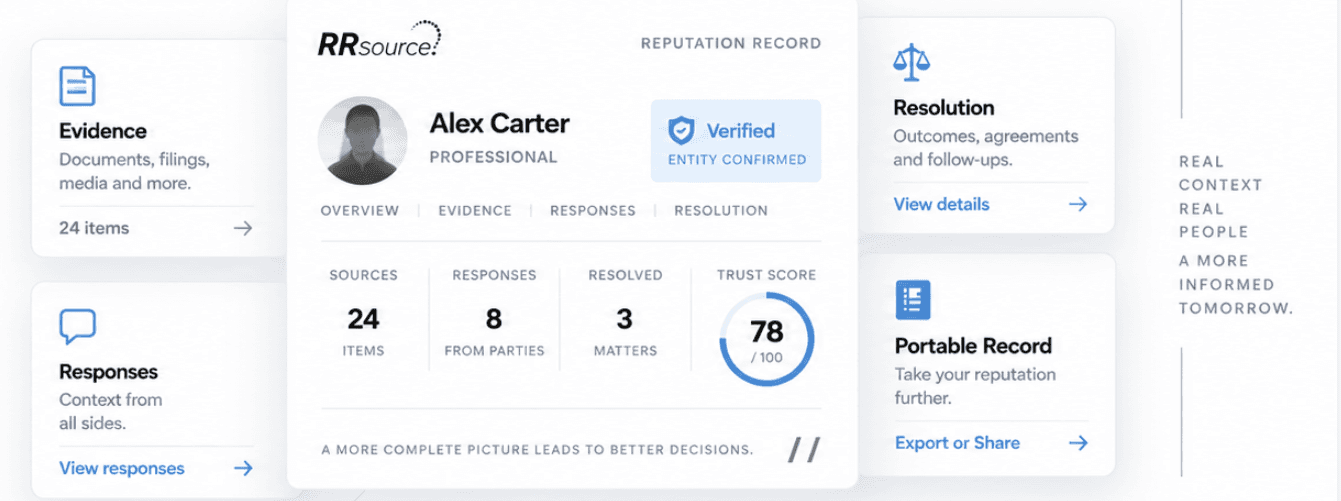
Rogue traders often change their business name and start again. Good tradespeople, meanwhile, have years of satisfied customers they cannot easily show. RRSource ties a portable Reputation Record to a verified identity, so good work builds a record that travels, disputes are recorded with both sides' evidence, and the outcome follows the evidence. Explore how RRSource is used across different industries.
Licensing, consumer rights and complaint routes vary by country and region.
Previous
Could Your Tenant Screening Be Discriminating Without You Knowing?
Next
Someone Posted an Unfair Review About You. Here's How to Respond Without Making It Worse
Loading comments…

AI may not value dollars, dinar or rupees. Reputation could become the currency machines understand. AI agents are beginning to shop, book services, buy compute and make payments on behalf of people and companies. But machines do not value pounds, dollars, dinar or rupees in the human sense. Money matters to them only because it unlocks something else: access, compute, data, permissions, time and reliable counterparties. As autonomous systems become economic actors, reputation could emerge as one of the most important currencies machines use to decide who — and what — they trust.

A good HGV driver can spend years building experience, trust and specialist knowledge, only to arrive at the next employer with little more than a licence, CPC card and CV. This guide explains how drivers can document their work as it happens — preserving training, assessments, references, incident outcomes and verified achievements so their professional history does not disappear every time they change jobs.

A valid HGV licence tells you whether someone is entitled to drive. It does not tell you everything about the professional history behind the person holding it. From references and employment continuity to CPC, tachograph compliance, driving assessments and documented incidents, this guide explains how employers can build a fuller picture before handing over the keys.