About this article: this is a review of published third-party research, not an RRSource survey. Sources are listed at the end.
Reference checks are one of the most common steps in hiring — and increasingly in renting and household hiring too. But how much do they actually tell you? The research gives a clear, if uncomfortable, answer: some, but less than most people assume.
Finding 1: References predict performance only modestly
Personnel psychologists have studied the predictive validity of hiring methods for decades — that is, how strongly each method's results correlate with later job performance. In the meta-analytic research of Frank Schmidt and John Hunter, and its later update by Schmidt and colleagues, reference checks show a validity of about .26.
For comparison, the same analysis reports considerably higher estimates for general mental ability tests and for employment interviews. A validity of .26 means references carry some useful information, but on their own they explain only a small share of the differences in how people later perform.
Two caveats matter. The estimates rest on limited underlying studies for references, and "reference check" covers a wide range of practices — from a two-line email to a structured interview with a former manager.
Finding 2: Employers are reluctant to say much
The same research notes that, despite laws in some places intended to protect employers who give honest references, employers remain reluctant to provide more than dates of employment and job titles. Neutral reference policies limit what references can reveal before a single question is asked.
Finding 3: CVs often contain inaccuracies
In a 2014 CareerBuilder survey conducted by Harris Poll of 2,188 US hiring managers and HR professionals, 58% said they had caught a lie on a résumé. Half (51%) said they would automatically dismiss a candidate for it. Surveys of this kind rely on self-reported experience and are not a measure of how many CVs contain falsehoods — but they show that verification catches real problems.
What the evidence suggests
- Do not rely on references alone. Combine them with structured interviews, practical assessments and verification of facts.
- Structure the conversation. Specific, behavioural questions yield more than open "any concerns?" prompts.
- Verify facts separately. Dates, qualifications and licences can be checked objectively.
- Expect gaps. A bland reference is normal and is not evidence either way.
The underlying problem
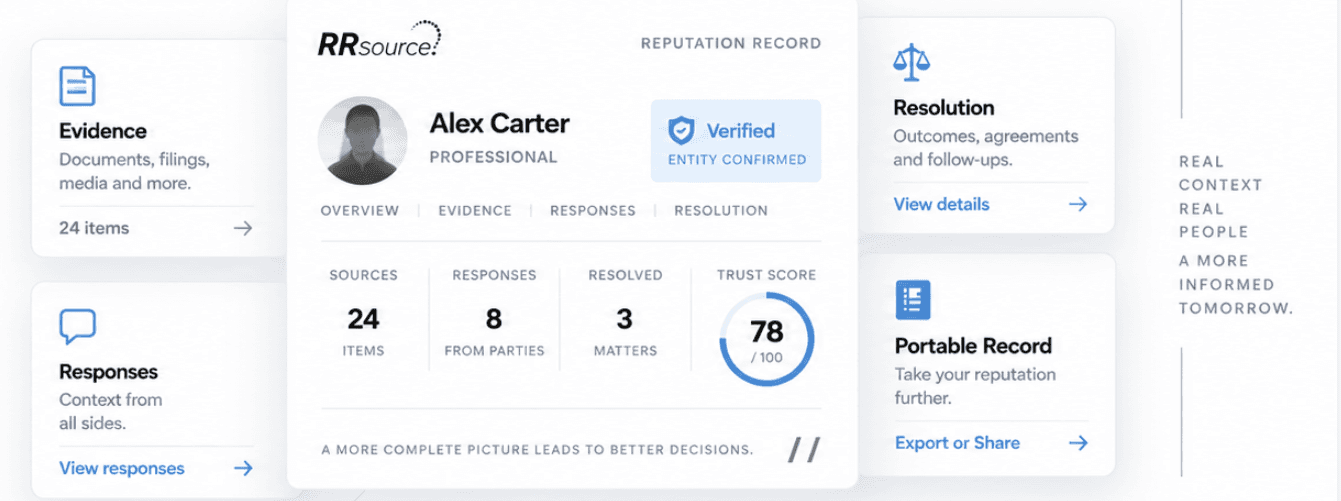
References are unstructured, chosen by the candidate, invisible to them and rarely include the other side of any issue. Read why references often tell you very little and background checks vs references. RRSource Reputation Records are designed around the opposite principles: structured reports, evidence, a right of reply and recorded Resolutions.
Sources
- Schmidt, F. L., & Hunter, J. E. (1998). The validity and utility of selection methods in personnel psychology: Practical and theoretical implications of 85 years of research findings. Psychological Bulletin, 124(2), 262–274.
- Schmidt, F. L., Oh, I.-S., & Shaffer, J. A. (2016). The validity and utility of selection methods in personnel psychology: Practical and theoretical implications of 100 years of research findings. Working paper.
- CareerBuilder, Fifty-eight percent of employers have caught a lie on a resume (August 2014; Harris Poll, 2,188 hiring managers and HR professionals)