RRSource Paper No. 001
Abstract
The digital age promised a more objective society.
Machines, unlike people, were supposed to make decisions without prejudice. An algorithm does not see race, religion, disability or gender in the way a human being does. It simply processes data and produces an outcome.
But this apparent neutrality can be deceptive.
Automated systems increasingly influence who gets hired, who receives credit, who is investigated for fraud, which applications receive attention, who is shown opportunities and, increasingly, how individuals and organisations are assessed for risk.
The central problem is not necessarily that machines are intentionally discriminatory. It is that automation can transform historical inequality, incomplete data, proxy variables and institutional assumptions into decisions that appear objective because a computer made them.
This problem has become particularly consequential during the second Trump administration, as the United States has simultaneously accelerated its push for artificial-intelligence leadership while changing the federal government's approach to civil-rights enforcement, diversity programmes and regulatory oversight. The administration's 2025 AI Action Plan contains more than 90 federal actions focused on AI innovation, infrastructure and international leadership, while executive actions have substantially changed federal policy surrounding DEI and civil-rights enforcement.
This paper does not argue that automation is inherently discriminatory, nor that every policy change under the Trump administration has reduced civil-rights protections. Rather, it asks a narrower question:
When increasingly consequential decisions are automated, what happens to people who are poorly represented, incorrectly classified, or unable to challenge the information being used to judge them?
RRSource proposes one possible part of the answer: evidence-linked reputation records that make the information behind reputation and trust decisions more visible, contestable and correctable.
Such records are not a substitute for civil-rights law, human judgment or algorithmic auditing. They are potentially another layer of accountability.
1. The Machine Does Not Have to Be Racist
An algorithm does not need to "hate" a minority group to produce discriminatory results.
This distinction is fundamental.
A traditional discriminatory decision might involve a person consciously deciding:
I don't want to hire this person because of their race.
Automated discrimination can look very different.
A system might use:
- previous hiring data
- geographic information
- educational history
- employment gaps
- purchasing behaviour
- language patterns
- online activity
- credit information
- criminal-record data
- facial or voice characteristics
- behavioural predictions
The system may never explicitly receive someone's race.
Yet variables that appear neutral can act as proxies for characteristics such as race, sex, disability, national origin or socioeconomic status.
The result can therefore be discriminatory without the system ever containing a field labelled "race."
The U.S. Equal Employment Opportunity Commission has recognised this problem. Its guidance on automated employment systems states that Title VII applies when software, algorithms or AI make or inform selection decisions, and that automated systems can have disparate impacts on protected groups.
NIST has similarly warned that digital information about people can be captured, quantified and used to categorise, sort, recommend or make decisions about their lives, while biases can enter technology processes even without discriminatory intent.
The crucial point is therefore:
Automation can hide discrimination behind the appearance of objectivity.
2. From Discrimination to Digital Discrimination
Traditional discrimination is visible.
Digital discrimination can be invisible.
A person rejected by a human may be able to ask:
Why?
A person rejected by an automated system may receive:
Your application did not meet our criteria.
The decision may have been generated by a model containing hundreds or thousands of variables.
This creates what might be called the accountability gap.
The person affected experiences the outcome.
The organisation owns the system.
The algorithm produces the decision.
But nobody may be able to clearly explain the precise chain connecting the individual to the outcome.
This problem is not theoretical.
In credit, for example, the Consumer Financial Protection Bureau has stated that creditors using complex algorithms must still provide specific reasons for adverse credit decisions; a creditor cannot avoid explanation simply because the decision came from a complex or "black-box" model.
The principle is important:
Automation should not eliminate the right to understand a consequential decision.
3. Minorities Can Be Disadvantaged by What the Machine Does Not Know
There is another form of digital discrimination that receives less attention.
Absence.
An algorithm cannot necessarily make a good prediction about someone for whom it has little reliable data.
Recent research has described this as algorithmic exclusion: an AI system may fail because it does not have enough information to produce a meaningful output about particular individuals or populations.
This matters for minority communities.
A person with:
- limited digital history
- a non-traditional employment history
- an uncommon name
- limited credit history
- migration between countries
- informal economic activity
- limited access to mainstream financial services
may be difficult for an automated system to classify.
The absence of data can then become a negative signal.
This creates a paradox:
The people least represented by the data can become the people most affected by decisions based on that data.
4. The Trump Era: Automation Meets a Changing Civil-Rights Environment
The second Trump administration provides an important contemporary case study because two major developments are occurring simultaneously.
First:
The United States is accelerating AI adoption.
Second:
The federal government's approach to civil-rights policy and enforcement has changed.
In January 2025, President Trump issued an executive order titled "Removing Barriers to American Leadership in Artificial Intelligence," directing the development of an AI Action Plan and reviewing policies associated with the previous administration's AI framework.
Six months later, the White House released "Winning the AI Race: America's AI Action Plan," outlining more than 90 federal actions across innovation, infrastructure and international diplomacy/security.
At the same time, the administration issued an executive order titled "Ending Illegal Discrimination and Restoring Merit-Based Opportunity," arguing that federal institutions and businesses had adopted race- and sex-based preferences under DEI programmes that the administration considered unlawful.
The administration has also issued subsequent directives concerning DEI discrimination by federal contractors.
These policies are politically contested.
Supporters describe them as a restoration of equal treatment and merit.
Critics argue that they weaken mechanisms designed to identify and remedy structural discrimination.
The distinction matters because the question of algorithmic discrimination cannot be separated entirely from the institutional environment in which algorithms operate.
5. The Enforcement Question
Civil-rights protections are only as effective as the ability to detect and challenge violations.
That becomes especially important when decisions are increasingly automated.
The EEOC has continued to address discrimination involving automated systems. In 2025, for example, it sued a staffing company alleging disability discrimination after a qualified deaf applicant was no longer pursued after requesting an accommodation.
The EEOC has also continued enforcement under the second Trump administration, reporting $660 million recovered for 17,680 victims of employment discrimination in fiscal year 2025.
These facts complicate simplistic narratives.
It would be inaccurate to say:
The Trump administration eliminated civil-rights enforcement.
It has not.
Nor would it be accurate to say:
The Trump administration's AI policies have been proven to discriminate against minorities.
That conclusion would require evidence that cannot be established simply from the policies themselves.
The more defensible observation is this:
The United States is entering a period in which increasingly consequential decisions are automated while the institutional and political framework for challenging discrimination is changing.
That creates a need for additional mechanisms of transparency and accountability.
6. The Problem With Reputation Systems
This brings us to reputation.
At first glance, reputation systems appear to solve part of the problem.
Instead of an opaque algorithm deciding everything, a person can potentially build a reputation based on their history.
But reputation systems can themselves become discriminatory.
A person's reputation may be affected by:
- false reports
- incomplete records
- identity confusion
- old information
- coordinated attacks
- cultural misunderstandings
- socioeconomic circumstances
- biased reporting
- lack of access to mechanisms for correcting information
A reputation score without context can therefore become another automated barrier.
A bad reputation system can simply automate prejudice.
RRSource therefore takes a different proposition.
A reputation record should not simply answer:
Is this person good or bad?
It should preserve the underlying information necessary to understand why a reputation signal exists.
7. From Reputation Scores to Reputation Records
This is where the concept of the Reputation Record becomes important.
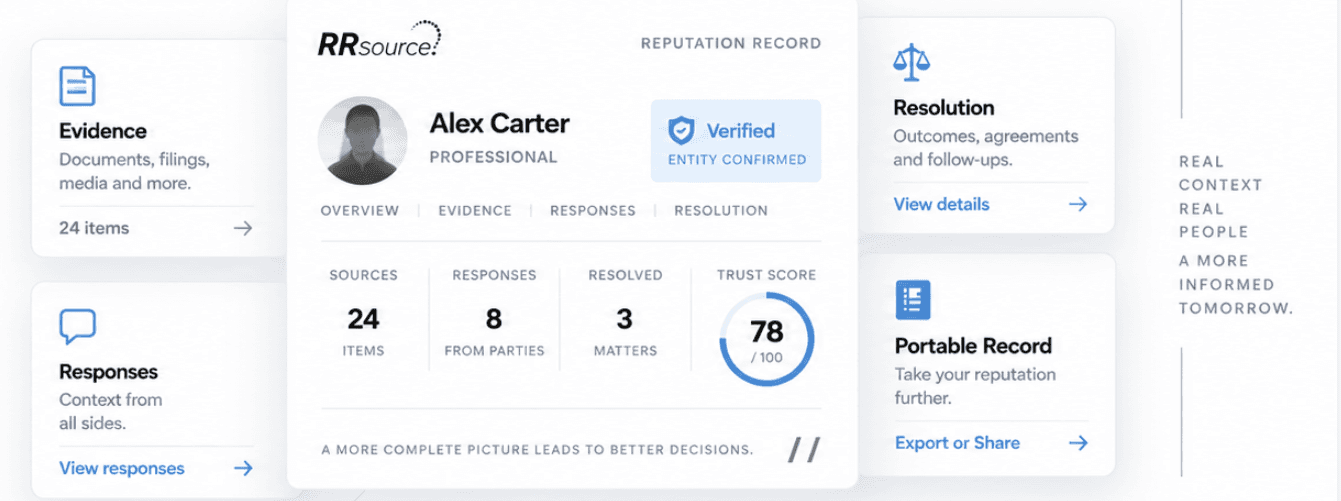
A Reputation Record should distinguish between:
Claim
What someone says happened.
Evidence
What material supports the claim.
Verification
What has been independently established.
Dispute
What the subject contests.
Response
What the subject says happened.
Resolution
What happened after investigation or dispute.
Status
Whether the record is active, disputed, resolved, withdrawn or otherwise qualified.
This distinction is critical.
A person should not simply receive:
RISK: HIGH
without understanding why.
Instead:
Reported: 12 March 2026
Claim: Non-delivery after payment
Evidence: Payment receipt + correspondence
Response: Seller disputed claim
Status: Disputed
That is fundamentally different from a black-box score.
8. Can Reputation Records Reduce Digital Discrimination?
Potentially — if designed correctly.
The argument is not that reputation records magically eliminate discrimination.
They cannot.
The proposition is more modest:
A transparent evidence-linked reputation record can give people something that opaque automated systems often do not: context and the opportunity to challenge the information being used to form a judgment.
Consider two systems.
System A — Black Box
Risk Score: 82/100
Application rejected.
The individual does not know:
- what information was used
- whether it was correct
- whether the information belongs to them
- whether the information was outdated
- whether the model used discriminatory proxies
- how to challenge it
System B — Reputation Record
Three reports exist.
One is verified.
One is disputed.
One was withdrawn.
Evidence is available for the verified record.
The subject has responded.
A decision-maker can now see the evidence behind the signal.
And the subject can see what is being said about them.
That is a meaningful difference.
9. Transparency Is Not Enough
There is an important warning here.
RRSource itself could become discriminatory if it is poorly designed.
That is why reputation intelligence must be governed differently from ordinary social media.
A credible reputation-record system should have:
Provenance
Where did the information come from?
Evidence
What supports the claim?
Identity resolution
Are we certain the record belongs to the correct person or business?
Contestability
Can the subject challenge it?
Correction
Can demonstrably false information be corrected?
Temporal context
How old is the information?
Status
Is the allegation unresolved, disputed or verified?
Human review
Can consequential decisions be escalated beyond an automated score?
Protected-characteristic safeguards
Race, ethnicity, religion, disability, sex and other protected characteristics should not become covert reputation variables.
These principles align with broader approaches to trustworthy AI. NIST's AI Risk Management Framework emphasises characteristics including accountability, transparency, explainability, privacy and fairness with harmful bias managed.
10. The Difference Between Verification and Discrimination
There is an uncomfortable question:
If reputation information can help prevent fraud, could it also be used to exclude people unfairly?
Yes.
That is precisely why verification should not become classification without explanation.
Knowing that an individual exists is not the same as knowing that they are trustworthy.
Knowing that someone has been reported is not the same as knowing that they committed wrongdoing.
Knowing that someone has a poor credit history is not the same as knowing why.
And knowing someone's identity should never automatically reveal protected characteristics that can then be used against them.
RRSource therefore has an opportunity to establish an important principle:
Identity should establish who someone is. Evidence should establish what happened. Reputation intelligence should establish what can reasonably be inferred — and what cannot.
11. A New Social Contract for Automated Decisions
The debate over AI is often framed as:
Human vs machine.
That is too simple.
The real issue is:
Opaque decision vs accountable decision.
A human can discriminate.
An algorithm can discriminate.
A crowd can discriminate.
A reputation platform can discriminate.
The solution is therefore not simply replacing one decision-maker with another.
The solution is building systems in which:
- information has provenance
- claims have context
- decisions can be challenged
- errors can be corrected
- and people are not permanently defined by an opaque score
12. RRSource's Proposition
RRSource's proposition is therefore not:
We can eliminate discrimination.
That would be an irresponsible claim.
The proposition is:
We can make reputation information more transparent, evidence-linked and contestable.
That matters because the future of trust will increasingly depend on information systems.
As more decisions become automated, the question will no longer simply be:
Can the machine make the right decision?
It will also be:
Can the person affected by the decision understand, challenge and correct the information that influenced it?
That is where Reputation Records can potentially contribute.
13. Conclusion
The age of automation is also an age of classification.
People are increasingly reduced to data points:
- credit risk
- fraud risk
- employment probability
- identity confidence
- customer value
- security risk
- reputation score
For many people, particularly those whose lives are poorly represented in conventional datasets, this creates a new form of vulnerability.
The danger is not simply that machines may make mistakes.
The deeper danger is that mistakes can become institutionalised when machines make them at scale.
The second Trump administration has accelerated America's push toward AI while simultaneously reshaping federal approaches to civil-rights enforcement, DEI and regulatory policy. The resulting environment makes questions about automated discrimination, accountability and contestability increasingly important.
But this is not fundamentally a partisan technological problem.
It is a human problem.
A conservative, liberal, immigrant, disabled person, religious minority, racial minority, business owner or ordinary consumer can all be harmed by an incorrect automated classification.
The question is whether the individual has a mechanism to challenge it.
RRSource believes one part of that mechanism can be the Reputation Record:
Not a score without context.
Not an accusation without evidence.
Not a decision without recourse.
But a record with provenance, evidence, context and the possibility of correction.
In a world increasingly governed by automated trust decisions, the ability to see and challenge the record behind the decision may become as important as the decision itself.
Author's Note
Logic is the author of RRSource Paper No. 001.
This paper represents an independent research and policy perspective and should not be interpreted as legal advice or as a finding that any individual, organisation or government policy is discriminatory. References to the Trump administration describe documented policies and developments; where claims about their consequences remain contested, the paper identifies them as such.
Sources & Further Reading
- NIST — Artificial Intelligence Risk Management Framework
- EEOC — AI and Automated Systems in Employment Decisions
- EEOC — Algorithmic Fairness and Employment Selection
- CFPB — Adverse Action and Complex Algorithms
- White House — America's AI Action Plan
- White House — Removing Barriers to American AI Leadership
- White House — Ending Illegal Discrimination and Restoring Merit-Based Opportunity
- Brookings — Artificial Intelligence and Algorithmic Exclusion