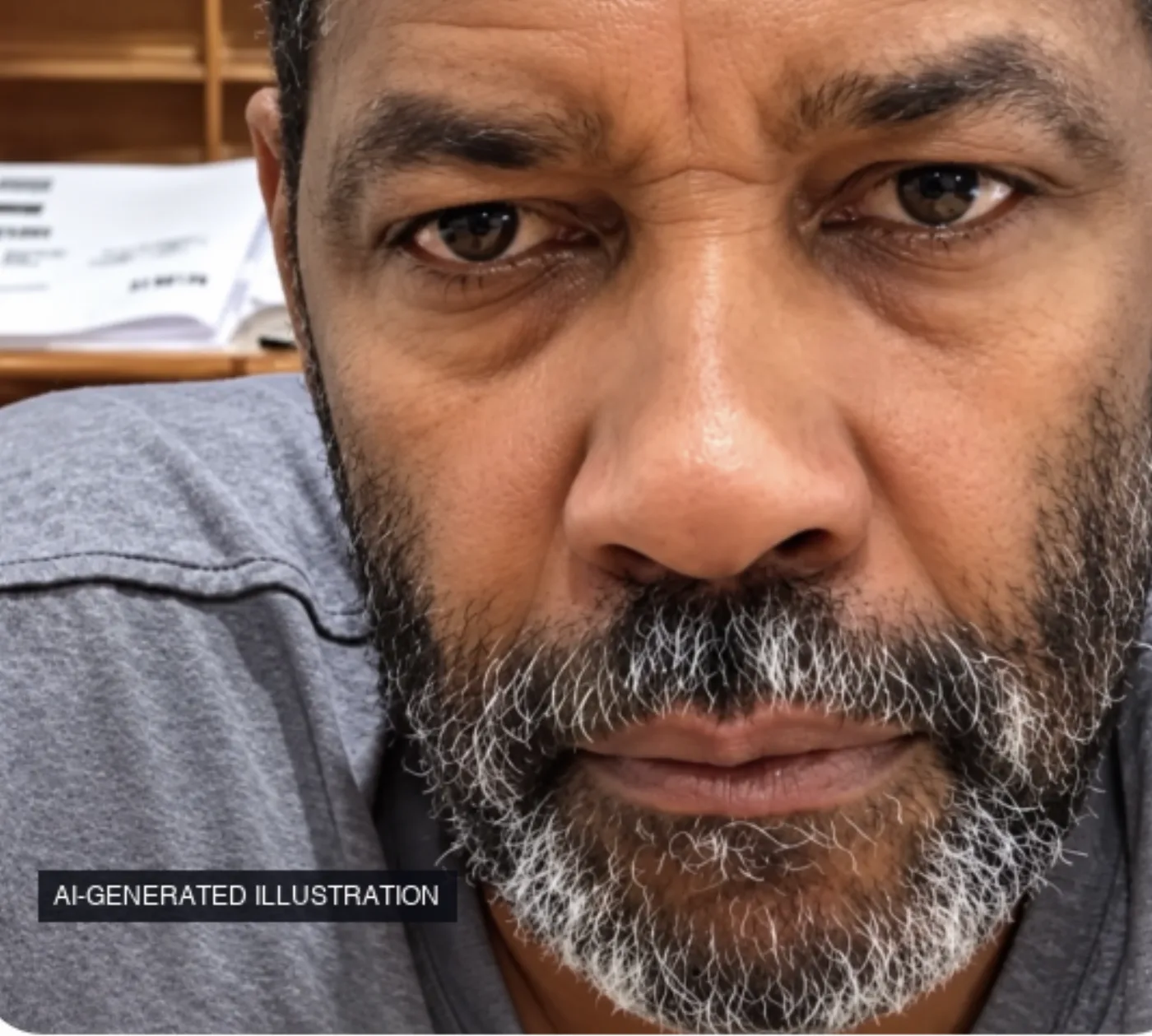
Denzel Washington has spent decades at the centre of the entertainment industry without allowing Hollywood to become the centre of his worldview. Now, as artificial intelligence begins to challenge some of the assumptions on which filmmaking has been built, his warnings about technology, influence and human creativity sound unusually timely.
Washington has been speaking increasingly openly about forces he believes are larger than fame, celebrity and the entertainment business. At the same time, he has begun addressing one of the most powerful technological forces now entering Hollywood: artificial intelligence.
And his position is remarkably clear.
“You cannot give artificial intelligence a soul”
In a 2025 interview surrounding Highest 2 Lowest, his fifth film with director Spike Lee, Washington was asked directly about AI.
His response went to the distinction he believes separates human creativity from machine production:
“You cannot give artificial intelligence a soul.”
He expanded the argument to include the human spirit, imagination and creativity.
In another interview, Washington acknowledged that technological fear itself is nothing new. Previous generations worried about new technologies too.
But he drew a line between technological capability and human experience.
Humans, he argued, possess a heart and soul. They suffer. They react. They experience feelings and emotions. Machines can imitate aspects of human output, but imitation is not the same thing as possessing the experiences from which human expression emerges.
That distinction is becoming more consequential because AI is no longer a distant hypothetical for Hollywood.
It is already arriving inside the machinery that makes movies.
Hollywood is quietly becoming an AI industry
The public argument about AI in entertainment initially centred on replacement: Would studios replace writers? Would actors' faces be digitally recreated? Would artists lose control of their work?
By 2026, the conversation has moved considerably further.
A Los Angeles Times investigation published in July examined hundreds of job listings at major entertainment companies and found that more than one in ten was likely connected with artificial intelligence. Studios were recruiting people both to develop AI systems and to protect their intellectual property from unauthorized AI use.
AI is also moving into creative development itself.
Producer Brian Grazer, co-founder of Imagine Entertainment, told the Los Angeles Times that he now begins developing some movie ideas by working with Anthropic's Claude before passing material to a human writer. The broader industry debate is increasingly shifting from whether AI will be used to where it will be used, who controls it, whose work trains it and who gets paid.
Netflix, Peacock and Prime Video have also been developing or deploying AI-related technology across production and viewer experiences.
So Washington's comments arrive during a genuine transformation.
Hollywood spent more than a century industrialising human imagination. AI raises a different possibility: industrialising portions of imagination itself.
The fear is bigger than CGI
Hollywood has encountered disruptive technologies before.
Sound replaced silent filmmaking. Colour transformed cinematography. Television challenged cinemas. Computer-generated imagery changed visual effects. Streaming dismantled established distribution models.
Generative AI differs in one important respect.
It does not merely give an artist another camera, editing system or visual effect. Some systems can generate the performance, voice, image, music, dialogue or visual environment themselves.
That distinction was central to Hollywood's labour disputes.
AI concerns helped fuel the 2023 strikes, particularly fears surrounding the reproduction of actors' likenesses and the use of generative systems in writing and production. Those arguments have continued as AI has become more capable.
The question is consequently moving beyond: Can AI help people make movies? Toward something considerably more uncomfortable: how much of a movie still needs to originate with a person?
Washington's argument is not that machines are useless
This is where Washington's position deserves more careful treatment than some viral headlines give it.
He has not presented a technical argument that AI cannot become extraordinarily capable.
Quite the opposite.
Discussing the technology, he observed that “the pace is increasing.”
His objection is philosophical.
A machine might eventually reproduce the external characteristics of a great performance with extraordinary precision. It could generate tears, hesitation, facial expressions, vocal inflection and dialogue.
But did it grieve?
Did it love?
Was it frightened?
Did it remember childhood?
Did it sacrifice something?
Did it believe what it was saying?
For Washington, those questions matter because art is not merely its finished appearance. Human experience is part of where art comes from.
Spike Lee has expressed essentially the same position, saying during their Highest 2 Lowest interviews that machines do not possess a heart or soul and drawing his own boundary around AI's role in art.
Then there is Washington's other warning
Long before the current generative-AI boom, Washington was describing modern life in explicitly spiritual terms.
In a 2021 interview he said: “This is spiritual warfare.”
He argued that without a “spiritual anchor,” people can become vulnerable to the forces surrounding them.
That wasn't an isolated remark.
Washington has publicly discussed his Christian faith for years. He has spoken about praying during productions and trying to put God first in his decisions.
In a lengthy November 2025 conversation with Bishop T.D. Jakes, Washington again discussed faith, purpose, digital dependency and what the programme described as navigating “spiritual warfare in Hollywood.” The discussion also addressed life in an era increasingly shaped by social media, AI and cultural fragmentation.
Interestingly, Washington also resisted treating “Hollywood” as some single mysterious entity.
During that conversation he pointed out that Hollywood is not a secret room where everybody gathers and makes collective decisions. He described himself much more simply as someone who makes movies, directs and performs in plays.
That qualification is important.
Washington's documented comments support a story about faith, technological power and the limits of artificial creativity. They do not establish claims about a hidden Hollywood power structure.
AI makes his argument harder to dismiss
The extraordinary thing about the present moment is that the philosophical question Washington raises is rapidly becoming a practical one.
For most of cinema's history, audiences could make one basic assumption: behind the image was a human act.
Someone stood before the camera.
Someone drew the picture.
Someone wrote the sentence.
Someone performed the voice.
Someone composed the music.
Generative AI begins breaking that chain.
An image can exist without a photographer witnessing the scene. A voice can exist without the speaker saying the words. A face can perform an action its owner never performed. A song can be generated without a singer experiencing the emotion being expressed.
The output may increasingly look human while its origin becomes less human.
That is the deeper significance of Washington's distinction between intelligence and soul.
He isn't really asking whether machines can become convincing.
They almost certainly will become considerably more convincing.
He's asking whether convincing is the same thing as human.
Hollywood itself has not resolved the contradiction
Perhaps the most revealing development is that Hollywood simultaneously fears AI and wants it.
Studios have fought AI companies over intellectual property while also investing in AI capabilities. Performers have sought contractual protections over digital replicas while producers experiment with AI-assisted production. Executives see potential cost reductions; artists see possible displacement.
The Los Angeles Times described an industry increasingly incorporating AI even as many performers publicly resist aspects of it.
That contradiction will probably define the next phase of filmmaking.
AI can make certain things faster. It can make some things cheaper. It can potentially allow tiny production teams to create images that once required enormous budgets.
But none of those advantages answers Washington's question.
What happens when technical capability becomes confused with creativity itself?
The real story is larger than Denzel Washington
Washington is approaching this transformation from a religious worldview. Someone need not share that theology to recognize the underlying question.
For centuries, technology primarily amplified human physical capability.
Machines allowed us to lift more, travel faster, calculate faster, manufacture more and communicate farther.
Artificial intelligence reaches into a different territory.
It can simulate abilities we have traditionally associated with the mind: language, reasoning, illustration, composition, conversation and increasingly moving images and performance.
That makes the current technological transition different from simply introducing another filmmaking tool.
It challenges society to decide which human activities we value because of their output and which we value because a human being performed them.
Washington's answer, at least where art is concerned, appears settled.
Technology can imitate. Technology can accelerate. Technology can become extraordinarily powerful.
But intelligence, in his view, should not be confused with imagination, emotion, spirit or soul.
And perhaps that is the more accurate version of the dramatic headline now circulating online.